Welcome!

Welcome to my Doula Blog! I hope you find it interesting and informative.

My name is Natalie. I am a wife, a mother of almost five boys, a doula, and a Hypnobabies Instructor! I'm passionate about childbirth and hope to help women realize the power that is in them to birth more normally and naturally. It's my goal to help women feel confident and comfortable during pregnancy, labor, and delivery. Yes, it is possible! It's also amazing, incredible, wonderful, empowering, and life changing.

As a doula, I am a trained professional who understands and trusts the process of birth. I provide continuous care for the laboring mother and her partner. Studies have shown that when doulas attend births, labors are shorter with fewer complications. I attend to women in labor to help ensure a safe and satisfying birth experience in both home and hospital settings. I draw on my knowledge and experience to provide emotional support, physical comfort and, as needed, communication with the other members of your birth team to make sure that you have the information that you need to make informed decisions in labor. I can provide reassurance and perspective to the laboring mother and her partner, make suggestions for labor progress, and help with relaxation, massage, positioning and other techniques for comfort.

Feel free to contact me at doulanataliesue@gmail.com.
Thanks for stopping by!

Pages

Showing posts with label Interventions. Show all posts

Thursday, June 9, 2011

The Myth of the Vaginal Exam

Vaginal exams. I don't know a single woman who likes them.
However, there is a myth perpetuated in our society that vaginal exams at the end of pregnancy are beneficial. The common belief is that by doing a vaginal exam one can tell that labor will begin soon. This is not the case.
Most practitioners will do an initial vaginal exam at the beginning of pregnancy to do a pap smear, and other testing. Then they don't do any until about the 36 week mark, unless complications arise that call for further testing or to assess the cervix. If your practitioner wants to do a vaginal exam at every visit, you should probably question them as to why.
Vaginal exams can measure certain things:
  • Dilation: How far your cervix has opened. 10 centimeters being the widest.
  • Ripeness: The consistency of your cervix. It starts out being firm like the tip of your nose, softening to what your ear lobe feels like and eventually feeling like the inside of your cheek.
  • Effacement: This is how thin your cervix is. If you think of your cervix as funnel-like, and measuring about 2 inches, you will see that 50% effaced means that your cervix is now about 1 inch in length. As the cervix softens and dilates the length decreases as well.
  • Station: This is the position of the baby in relation to your pelvis, measured in pluses and minuses. A baby who is at 0 station is said to be engaged, while a baby in the negative numbers is said to be floating. The positive numbers are the way out!
  • Position of the baby: By feeling the suture lines on the skull of the baby, where the four plates of bone haven't fused yet, one can tell you which direction the baby is facing because the anterior and posterior fontanels (soft spots) are shaped differently.
  • Position of the cervix: The cervix will move from being more posterior to anterior. Many women can tell when the cervix begins to move around because when a vaginal exam is performed it no longer feels like the cervix is located near her tonsils.
What this equation leaves to be desired is something that is not always tangible. Many people try to use the information that is gathered from a vaginal exam to predict things like when labor will begin or if the baby will fit through the pelvis. A vaginal exam simply cannot measure these things.
Labor is not simply about a cervix that has dilated, softened or anything else. A woman can be very dilated and not have her baby before her due date or even near her due date. I've personally had women who were 6 centimeters dilated for weeks. Then there is the sad woman who calls me to say that her cervix is high and tight, she's been told that this baby isn't coming for awhile, only to be at her side as she gives birth within 24 hours. Vaginal exams are just not good predictors of when labor will start.
Using a vaginal exam to predict advisability for a vaginal birth is usually not very accurate, for several reasons. First of all it leaves out the factor of labor and positioning. During labor it's natural for the baby's head to mold and the mother's pelvis to move. If done in early pregnancy it also removes the knowledge of what hormones like Relaxin will do to help make the pelvis, a moveable structure, be flexible. The only real exception to this is in the case of a very oddly structured pelvis. For example, a mother who was in a car accident and suffered a shattered pelvis or someone who might have a specific bone problem, which is more commonly seen where there is improper nutrition during the growing years.
During labor vaginal exams can't tell you exactly how close you are either, so keeping them to a minimum then is also a good idea, particularly if your membranes have ruptured.
Okay, so there's not really a great reason to have a vaginal in exam done routinely for most women. So are there any reasons not to have vaginal exams? There sure are.
Vaginal exams can increase the risks of infection, even when done carefully and with sterile gloves, etc. It pushes the normal bacteria found in the vagina upwards towards the cervix. There is also increased risk of rupturing the membranes. Some practitioners routinely do what is called stripping the membranes, which simply separates the bag of waters from the cervix. The thought behind this is that it will stimulate the production of prostaglandins to help labor begin and irritate the cervix causing it to contract. This has not been shown to be effective for everyone and does have the aforementioned risks.
In the end only you and your practitioner can decide what is right for your care in pregnancy. Some women refuse vaginal exams altogether, so request to have them done only after 40 weeks, or every other week or whatever she feels comfortable with.

Wednesday, May 4, 2011

The trouble with Extrapolating Hospital Birth Events to Homebirth

“If I were at home, I would have died” — The trouble with Extrapolating Hospital Birth Events to Homebirth

A midwife in North Carolina was recently charged with practicing midwifery without a license because her state does not license Certified Professional Midwives (CPMs) and other direct entry midwives.  There was some local news coverage of the arrest and the ongoing efforts of North Carlina families to legalize CPMs. One of the local news stories contained the “If I were at home, I would have died” sentiment.
When I hear statements like this I cringe on the inside.  Being a midwife, I hear it a lot.  Women love to talk about their birth stories, naturally. In the park, at mom’s groups, among new friends, anywhere women gather there are stories of births and babies being told. When a mother begins telling me her story from the “I would have died at home” perspective, I nod with empathy and say mmm hmm.
A typical hospital birth hook-up: pitocin to speed up labor, epidural medication, and an IV bag. Pitocin use in labor makes women more likely to hemorrhage after birth.
It’s a bit of a double bind (midwives and doulas — you know what I am talking about). Every woman’s story is inherently valid and it is her story to tell, her journey. On the other hand, my inner advocate of truth wants to illuminate the myths and realities of the hospital birth industry. In these moments I strive to listen with deep gratitude, kindness and love. The best I can do is to honor the mother’s feelings and experiences while side-stepping all the nuts and bolts of the “I/we would have died” argument. That can get messy; So often, it is the unnecessary interventions that cause the emergencies.
But since it’s coming up in the again in the media and a larger audience of women is hearing such emotionally charged statements about homebirth, it’s time to get messy. Why do women in the US die while giving birth? No one knows for certain because our reporting methods for maternal mortality are so abysmal. We think, based on fractured US statistics and older studies, that the primary causes of death to women during birth or shortly after are thromboembolism, preeclampsia/eclampsia, hemorrhage, infection, and anesthesia deaths.
Lets look at hemorrhage because it is the most likely to occur in a homebirth setting, though the risk is extremely small when compared with hospital birth.
Here are a few reasons why. Homebirth and hospital birth are supported by two divergent models of care. The homebirth model subscribes to the philosophy of don’t fix what isn’t broken: natural processes generally work best when they are not interfered with. The medical model subscribes to the (more profitable) philosophy of action: pregnancy and birth are conditions that require fixing.  All actions and interventions have consequences. Many of the interventions in a typical hospital birthcause complications, like hemorrhage.  These interventions do not happen at home.
New research demonstrates that women whose labors are altered by prolonged exposure to pitocin are more likely to hemorrhage after their birth. This is because oxytocin, our body’s own version of pitocin, helps the uterus to contract after birth and minimize blood loss. Pitocin binds to oxytocin receptor sites, and over time the body becomes desenstitized to it, preventing the uterus from contracting normally and leading to hemorrhage.  Regrettably, we’ve gotten to a point now where most births in the US are started artificially with the help of pitocin (induction) or hurried along by it (augmentation). Homebirth midwives do not use pitocin to start or speed up labor.
Immediate postpartum interventions can also lead to hemorrhage. The period just after birth is a unique and potent time biologically for the mother and baby. A natural flood of hormones connects mother and baby physically and emotionally, and helps the mother safely birth her placenta. The mother’s hormone levels will never be as high as this hour after birth; and when this flow is is disrupted the mother is more likely to bleed excessively.
Interventions during this immediate postpartum time are routine in a hospital setting: failing to give the baby to the mother immediately, assessing the baby away from the mother, pulling on the umbilical cord, changing the mother’s position to suit the care provider, diverting the mother’s attention away from the baby, clamping and cutting the umbilical cord without any good reason to do so, etc.
Midwives honor the biological importance of the hormonal bubble after birth and do not intervene unless the mother or baby needs help.
In a typical homebirth, mother and baby are undisturbed after birth. The midwife does not unnecessarily poke, prod, clamp, or otherwise interfere with the mother and baby unit.
When you hear someone say “I would have died if I had a homebirth” or “my baby would have died” please remember that these are very emotionally charged declarations. In many cases, unnecessary interventions have causedthe complications that women and babies suffer from.  (The CDC has estimated that half of maternal deaths are preventable).
You can’t simply cut and paste all the circumstances surrounding a given hospital birth, superimpose them on a homebirth setting, and predict the same outcome — or vice versa. The models of care are too divergent. Women can die from birth complications in any setting, and our hospital death rate from birth-related causes is indefensibly high. We know that low-risk women are as safe, if not safer, birthing at home.

The United States ranks 41st in maternal mortality among nations. That means in 40 other countries, women are less likely to die from pregnancy and birth related causes. The CDC also states that half of the reported deaths were preventable and that death rates are underreported by almost a third. On April 9th the Healthy Mothers Healthy Birth Summit will convene in Washington D.C. to examine the clinical and political issues surrounding maternal death in the United States.

Saturday, August 21, 2010

In Defense of the Amniotic Sac

Artificial rupture of membranes (ARM) aka ‘breaking the waters’ is a common intervention during birth. However, an ARM should not be carried out without a good understanding of how the amniotic sac and fluid function in labour. Women need to be fully informed of the risks associated this intervention before agreeing to alter their labour in this way. This post will discuss how the ‘waters’ work in labour and the implications of breaking them.
Anatomy and physiology
By the end of pregnancy the baby is surrounded by around 500-1000mls of Fluid. This is mostly made up of amniotic fluid secreted by the amniotic sac (the membranes). The baby also contributes urine and respiratory tract secretions into the fluid. The amniotic fluid is constantly being produced and renewed – Baby swallows the fluid; it is passed through the gut into the baby’s circulation; then sent out through the placenta. This process continues even if the amniotic membranes have broken. So, even when the waters have ‘gone’ there is still some fluid present ie. there is no such thing as a ‘dry labour’.
The amniotic membrane is adhered to the chorion – another membrane between the amniotic membrane and the uterus. These membranes look like one, but you can tease them apart after birth.
During pregnancy
The amniotic sac protects and prepares baby by:
  • Cushioning any bumps to the abdomen.
  • Maintaining a constant temperature.
  • Allowing movement to aid muscle development.
  • Creating space for growth.
  • Protecting against infection – the membranes provide a barrier + the fluid contains antimicrobial peptides.
  • Assisting lung development – baby breathes fluid in and out of the lungs.
  • Taste and smell – the smell of amniotic fluid has been found to have a calming effect on newborns (Varendia et al. 1998).
After 40 weeks gestation around 20% of baby’s will pass meconium into their amniotic fluid as the bowels reach maturity and begin to work.  This is perfectly normal and is not a sign of distress. This meconium is diluted and processed with the amniotic fluid as described above.
During labour
Around 80-90% of women start their labour with their membranes intact. This is probably because the amniotic sac plays an important role in the physiology of a natural birth.
General fluid pressure
During a contraction the pressure is equalised throughout the fluid rather than directly squeezing the baby, placenta and umbilical cord. This protects the baby and his/her oxygen supply from the effects of the powerful uterine contractions. When the membranes have ruptured the placenta and baby get compressed during a contraction. Most babies can cope well with this, but the experience of birth for the baby is probably not as pleasant. When the placenta is compressed blood circulation is interrupted reducing the oxygen supply to baby. In addition, the umbilical cord may be in a position where it gets squashed between baby and uterus with contractions. When this happens the baby’s heart rate will dip during a contraction in response to the reduced blood flow. A healthy baby can cope with this intermittent reduction in oxygen supply for hours (it’s a bit like holding your breath for 30 seconds every few minutes). However, this is probably not so great to do for an extended period of time.
Forewaters
The sac of amniotic fluid is describes as having two sections – the forewaters (in front of baby’s head) and the hind waters (behind baby’s head). A ‘hind water leak’ refers to a tear in the the amniotic membranes behind the baby’s head. Often this is experienced by the woman as an occasional light trickle as the fluid has to run down the outside of the sac and past baby’s head to get out.
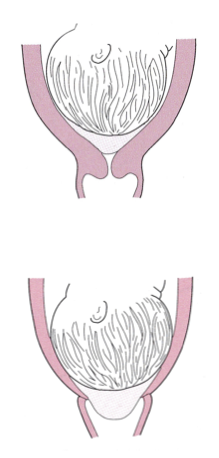
During labour forewaters are formed as the lower segment of the uterus stretches and the chorion (the external membrane) detaches from it. The well flexed baby’s head fits into the cervix and cuts off the fluid in front of the head from the fluid behind (hind waters). Pressure from contractions cause the forewaters to bulge downwards into the dilating cervix and eventually through into the vagina. This protects the forewaters from the high  pressure applied to the hind waters during a contraction and keeps the membranes intact. The forewaters transmit pressure evenly over the cervix which aids further dilatation. When the baby is in an OP position the head may not flex as well to block off the hind waters = pressure is able to move into the forewaters and they may rupture. Early rupture of membranes if often a feature of an OP labour.
Lubrication
The forewaters usually break when the cervix is almost fully open and the membranes are bulging so far into the vagina that they burst. This ‘fluid burst’ lubricates the vaginal and perineum to facilitate movement of the baby and stretching of the tissues.
Born in the caul
If is fairly common for a baby to be born in the amniotic sac when labour is left to unfold without interference. I have some beautiful photos of this but don’t have permission from the parents to share them online – so if you want to see them you will have to come and study midwifery at USC. However, I have found: Some photos of a waterbirth in the caulon Pamela Hines blog; photos of a land birth in the caul on Navelgazing Midwife’s blog; and a youtube movie:
Although in the movie the midwife breaks the membranes this is not necessary. Eventually the force of the contraction and the movement of the baby will rupture the sac as the baby’s body is born. This can be rather dramatic and messy and is another good reason for the midwife not to be fiddling about at the perineum during birth. A waterbirth in the caul is possibly one of the most amazing sights in the world (and less messy than on land). Once the baby is born the membranes can be peeled off – see the photo at the top of this post.
Historically being born in the caul was considered good luck for the baby. It was also believed that a baby who was born in the caul would be protected from drowning. Midwives used to dry out amniotic membranes and sell them to sailors as a talisman to protect them from drowning. Very enterprising!
Artificial rupture of membranes (ARM) aka amniotomy
Breaking the membranes with an amni-hook is a common intervention during labour. It is the first step in the induction process (see previous post), and also done in an attempt to speed up spontaneous labour. In an induced labour, intact membranes prevent the artificially created contractions from getting into an effective pattern. There is also the theoretical risk of an induced contraction (that is too strong) forcing amniotic fluid through the membranes/placenta and into the blood system causing an amniotic embolism and maternal death. So an ARM is necessary before a syntocinon/pitocin infusion is started.
In a spontaneous labour the rationale for an ARM is that once the forewaters have gone the hard baby’s head will apply direct pressure to the cervix and open it quicker. However, a cochrane review of the available research states that “the evidence showed no shortening of the length of first stage of labour and a possible increase in caesarean section. Routine amniotomy is not recommended for normally progressing labours or in labours which have become prolonged.”
There are also risks associated with an ARM:
  • It may increase contraction intensity and pain which can result in the woman feeling unable to cope and choosing an epidural… intervention rollercoaster begins.
  • The baby may become distressed due to compression of the placenta, baby and/or cord (as described above).
  • The umbilical cord may be swept down by the waters and either past the baby’s head or wedged next to the baby’s head. This is called a ‘cord prolapse’ and is an emergency situation. The compression of the cord interrupts or stops the supply of oxygen to the baby and the baby must be born asap by c-section. The only cord prolapse I have been involved with happened after an ARM (not done by me  - honest!). The outcome for the woman was a live baby born by emergency c-section. Her previous 2 babies had been vaginal births.
  • If there is a blood vessel running through the membranes (see picture below) and the amni-hook ruptures the vessel the baby will lose blood volume fast – another emergency situation.
  • There is a slight increase in the risk of infection but mostly for the mother (not baby). This risk is minimal if nothing is put into the vagina during labour (ie. hands, instruments etc.).
Summary
The amniotic sac and fluid play an important role in facilitating birth and protecting the baby. There is no evidence that rupturing this sac will reduce the length of labour. While every intervention has it’s place including ARM, midwives need to carefully consider the risks before offering it to women. Also women must be fully informed of the risks before choosing an ARM during their labour.

Monday, February 8, 2010

The Case Against Inducing Labor

Wow, THIS is an incredible article that was just posted by a fellow doula friend..for anyone curious about learning more of Pitocen and Inductions, this is very informative!

Especially to me because, I myself, have had 2 inductions. The reasons?
1. I was 9 days overdue and my amniotic fluid levels were low and
2. I was 5 days overdue and they thought I had a 9 1/2 pound baby in there.

For reason number 1, now I know that I could have been dehydrated, or maybe not. It really could have been a medical need. I'm not sure what else I could have done in that situation.
For number 2, I should have waited! I could have pushed out a big baby! Plus, when I had him, he was only 8 lbs. Now my care provider is wonderful, I don't want anyone to think differently. She was wonderful because she told me all of my options. She didn't force or make me choose one option over another. She repeatedly told me that it was up to me and that she would support my decisions. So I only blame myself for not doing more research.

After I had my babies, I started attending births of my amazing sister-in-laws. They all have natural childbirths. Witnessing them changed my life. I thought, "If they can do this, then I can do this!" "Childbirth IS normal and natural, but we are blessed with medical care in case we have a complication....otherwise, you really don't need medical interventions!" Do you know that my aunt had a couple of her babies FOUR weeks overdue? Yeah, and everyone is fine. Amazing. So after witnessing my sisters-in-law, and learning so much more about childbirth, I decided to become a Doula! I have learned SO much and am amazing at how much knowledge and power women are missing out on. I had no idea it was out there. Society trains us to think that childbirth is scary, painful, and the only way we are to do it is check ourselves into the hospital and sit in bed with our epidural. Well, it doesn't have to be this way. Because of what I have learned and what I have learned at the 10 births I have attended, you can be sure that I will be avoiding any more inductions with my own pregnancies....

Some points that stood out to me, or should I say, yelled out to me are these:

-Pitocin has a 40 to 50 percent induction failure rate. This is why you hear of induced women who fail to progress and end up with a c-section.

-In 1978, the FDA advisory committee removed its approval of Pitocin for the elective induction of labor.

-The drug has never been approved by the FDA for the use of augmenting labor..(speeding labor along).

-Only 3 percent of women need to be induced for medical reasons.

-Another 3 to 12 percent seem to want to drive their mothers crazy and hang out inside that wonderful, warm, loving womb, so they are induced well after their due dates...Yet we hear of Pitocen being used at almost every birth, when really, it should only be an option at 15% of births.

- Your due date that is still only 85 percent accurate, plus or minus 14 days. Actually, the percentage of babies born exactly on their predicted due date is so small it's a wonder we bother with due dates at all. It's perfectly normal for 80 percent of healthy babies to have anywhere from a 38- to 42-week gestation. Several generations ago, a physician might tell an expectant mother that she was due "sometime in late October or early November"; today, women are given a "precise" due date, often determined by ultrasound testing. Many instances of so-called postmaturity result from nothing more than an inaccurate due date. It's probably best to stick with the "late November, early December" method"

-The fact that Pitocin can shorten the normal oxygenating intervals that occur between contractions is a threat to the integrity of the fetal brain and can have lifelong consequences for the affected baby. (One compelling theory, presented at the 1996 annual meeting of the American Psychiatric Association by Eric Hollander of Mount Sinai Medical Center in New York, links autistic children with Pitocin-induced labors. Hollander suspects that Pitocin interferes with the newborn's oxytocin system, producing the social phobias of autism. When he administered oxytocin to autistic patients, it made them four times more talkative, and according to the patients themselves, twice as happy, although not all patients responded.) -This was the most interesting piece of information to me, as I might have a child with autism....my frist induction. He did not react well to the pitocen..


** And now, for all of us who have had pitocen, we cannot feel guilty. We can only take this information and share it with our sisters, friends, and empower our own lives for the future....