
Welcome!

Welcome to my Doula Blog! I hope you find it interesting and informative.

My name is Natalie. I am a wife, a mother of almost five boys, a doula, and a Hypnobabies Instructor! I'm passionate about childbirth and hope to help women realize the power that is in them to birth more normally and naturally. It's my goal to help women feel confident and comfortable during pregnancy, labor, and delivery. Yes, it is possible! It's also amazing, incredible, wonderful, empowering, and life changing.

As a doula, I am a trained professional who understands and trusts the process of birth. I provide continuous care for the laboring mother and her partner. Studies have shown that when doulas attend births, labors are shorter with fewer complications. I attend to women in labor to help ensure a safe and satisfying birth experience in both home and hospital settings. I draw on my knowledge and experience to provide emotional support, physical comfort and, as needed, communication with the other members of your birth team to make sure that you have the information that you need to make informed decisions in labor. I can provide reassurance and perspective to the laboring mother and her partner, make suggestions for labor progress, and help with relaxation, massage, positioning and other techniques for comfort.

Feel free to contact me at doulanataliesue@gmail.com.
Thanks for stopping by!

Pages

Saturday, August 21, 2010

In Defense of the Amniotic Sac

Artificial rupture of membranes (ARM) aka ‘breaking the waters’ is a common intervention during birth. However, an ARM should not be carried out without a good understanding of how the amniotic sac and fluid function in labour. Women need to be fully informed of the risks associated this intervention before agreeing to alter their labour in this way. This post will discuss how the ‘waters’ work in labour and the implications of breaking them.
Anatomy and physiology
By the end of pregnancy the baby is surrounded by around 500-1000mls of Fluid. This is mostly made up of amniotic fluid secreted by the amniotic sac (the membranes). The baby also contributes urine and respiratory tract secretions into the fluid. The amniotic fluid is constantly being produced and renewed – Baby swallows the fluid; it is passed through the gut into the baby’s circulation; then sent out through the placenta. This process continues even if the amniotic membranes have broken. So, even when the waters have ‘gone’ there is still some fluid present ie. there is no such thing as a ‘dry labour’.
The amniotic membrane is adhered to the chorion – another membrane between the amniotic membrane and the uterus. These membranes look like one, but you can tease them apart after birth.
During pregnancy
The amniotic sac protects and prepares baby by:
  • Cushioning any bumps to the abdomen.
  • Maintaining a constant temperature.
  • Allowing movement to aid muscle development.
  • Creating space for growth.
  • Protecting against infection – the membranes provide a barrier + the fluid contains antimicrobial peptides.
  • Assisting lung development – baby breathes fluid in and out of the lungs.
  • Taste and smell – the smell of amniotic fluid has been found to have a calming effect on newborns (Varendia et al. 1998).
After 40 weeks gestation around 20% of baby’s will pass meconium into their amniotic fluid as the bowels reach maturity and begin to work.  This is perfectly normal and is not a sign of distress. This meconium is diluted and processed with the amniotic fluid as described above.
During labour
Around 80-90% of women start their labour with their membranes intact. This is probably because the amniotic sac plays an important role in the physiology of a natural birth.
General fluid pressure
During a contraction the pressure is equalised throughout the fluid rather than directly squeezing the baby, placenta and umbilical cord. This protects the baby and his/her oxygen supply from the effects of the powerful uterine contractions. When the membranes have ruptured the placenta and baby get compressed during a contraction. Most babies can cope well with this, but the experience of birth for the baby is probably not as pleasant. When the placenta is compressed blood circulation is interrupted reducing the oxygen supply to baby. In addition, the umbilical cord may be in a position where it gets squashed between baby and uterus with contractions. When this happens the baby’s heart rate will dip during a contraction in response to the reduced blood flow. A healthy baby can cope with this intermittent reduction in oxygen supply for hours (it’s a bit like holding your breath for 30 seconds every few minutes). However, this is probably not so great to do for an extended period of time.
Forewaters
The sac of amniotic fluid is describes as having two sections – the forewaters (in front of baby’s head) and the hind waters (behind baby’s head). A ‘hind water leak’ refers to a tear in the the amniotic membranes behind the baby’s head. Often this is experienced by the woman as an occasional light trickle as the fluid has to run down the outside of the sac and past baby’s head to get out.
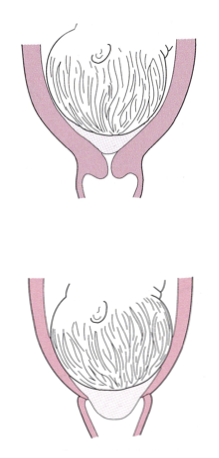
During labour forewaters are formed as the lower segment of the uterus stretches and the chorion (the external membrane) detaches from it. The well flexed baby’s head fits into the cervix and cuts off the fluid in front of the head from the fluid behind (hind waters). Pressure from contractions cause the forewaters to bulge downwards into the dilating cervix and eventually through into the vagina. This protects the forewaters from the high  pressure applied to the hind waters during a contraction and keeps the membranes intact. The forewaters transmit pressure evenly over the cervix which aids further dilatation. When the baby is in an OP position the head may not flex as well to block off the hind waters = pressure is able to move into the forewaters and they may rupture. Early rupture of membranes if often a feature of an OP labour.
Lubrication
The forewaters usually break when the cervix is almost fully open and the membranes are bulging so far into the vagina that they burst. This ‘fluid burst’ lubricates the vaginal and perineum to facilitate movement of the baby and stretching of the tissues.
Born in the caul
If is fairly common for a baby to be born in the amniotic sac when labour is left to unfold without interference. I have some beautiful photos of this but don’t have permission from the parents to share them online – so if you want to see them you will have to come and study midwifery at USC. However, I have found: Some photos of a waterbirth in the caulon Pamela Hines blog; photos of a land birth in the caul on Navelgazing Midwife’s blog; and a youtube movie:
Although in the movie the midwife breaks the membranes this is not necessary. Eventually the force of the contraction and the movement of the baby will rupture the sac as the baby’s body is born. This can be rather dramatic and messy and is another good reason for the midwife not to be fiddling about at the perineum during birth. A waterbirth in the caul is possibly one of the most amazing sights in the world (and less messy than on land). Once the baby is born the membranes can be peeled off – see the photo at the top of this post.
Historically being born in the caul was considered good luck for the baby. It was also believed that a baby who was born in the caul would be protected from drowning. Midwives used to dry out amniotic membranes and sell them to sailors as a talisman to protect them from drowning. Very enterprising!
Artificial rupture of membranes (ARM) aka amniotomy
Breaking the membranes with an amni-hook is a common intervention during labour. It is the first step in the induction process (see previous post), and also done in an attempt to speed up spontaneous labour. In an induced labour, intact membranes prevent the artificially created contractions from getting into an effective pattern. There is also the theoretical risk of an induced contraction (that is too strong) forcing amniotic fluid through the membranes/placenta and into the blood system causing an amniotic embolism and maternal death. So an ARM is necessary before a syntocinon/pitocin infusion is started.
In a spontaneous labour the rationale for an ARM is that once the forewaters have gone the hard baby’s head will apply direct pressure to the cervix and open it quicker. However, a cochrane review of the available research states that “the evidence showed no shortening of the length of first stage of labour and a possible increase in caesarean section. Routine amniotomy is not recommended for normally progressing labours or in labours which have become prolonged.”
There are also risks associated with an ARM:
  • It may increase contraction intensity and pain which can result in the woman feeling unable to cope and choosing an epidural… intervention rollercoaster begins.
  • The baby may become distressed due to compression of the placenta, baby and/or cord (as described above).
  • The umbilical cord may be swept down by the waters and either past the baby’s head or wedged next to the baby’s head. This is called a ‘cord prolapse’ and is an emergency situation. The compression of the cord interrupts or stops the supply of oxygen to the baby and the baby must be born asap by c-section. The only cord prolapse I have been involved with happened after an ARM (not done by me  - honest!). The outcome for the woman was a live baby born by emergency c-section. Her previous 2 babies had been vaginal births.
  • If there is a blood vessel running through the membranes (see picture below) and the amni-hook ruptures the vessel the baby will lose blood volume fast – another emergency situation.
  • There is a slight increase in the risk of infection but mostly for the mother (not baby). This risk is minimal if nothing is put into the vagina during labour (ie. hands, instruments etc.).
Summary
The amniotic sac and fluid play an important role in facilitating birth and protecting the baby. There is no evidence that rupturing this sac will reduce the length of labour. While every intervention has it’s place including ARM, midwives need to carefully consider the risks before offering it to women. Also women must be fully informed of the risks before choosing an ARM during their labour.

Tuesday, August 3, 2010

Normal Newborn Behavior and Why Breastmilk Isn't Just Food


What is a normal, term human infant supposed to do?

First of all, a human baby is supposed to be born vaginally. Yes, I know that doesn't always happen, but we're just going to talk ideal, normal for now. We are supposed to be born vaginally because we need good bacteria. Human babies are sterile, without bacteria, at birth. It's no accident that we are born near the anus, an area that has lots of bacteria, most of which are good and necessary for normal gut health and development of the immune system. And the bacteria that are there are mom's bacteria, bacteria that she can provide antibodies against if the bacteria there aren't nice.

Then the baby is born and is supposed to go to mom. Right to her chest. The chest, right in between the breasts is the natural habitat of the newborn baby. (Fun factoid: our cardiac output, how much blood we circulate in a given minute, is distributed to places that are important. Lots goes to the kidney every minute, like 10% or so, and 20% goes to your brain. In a new mom, 23% goes to her chest- more than her brain. The body thinks that place is important!)

That chest area gives heat. The baby has been using mom's body for temperature regulation for ages. Why would they stop? With all that blood flow, it's going to be warm. The baby can use mom to get warm. When I was in my residency, we would put a cold baby "under the warmer" which meant a heater thingy next to mom. Now, as I have matured, if a baby is "under the warmer," the kid is under mom. I wouldn't like that. I like the kids on top of mom, snuggled.

Now we have a brand new baby on the warmer. That child is not hungry. Bringing a hungry baby into the world is a bad plan. And really, if they were hungry, can you please explain to me why my kids sucked the life force out of me in those last few weeks of pregnancy? They better have been getting food, or well, that would have been annoying and painful for nothing.

Every species has instinctual behaviors that allow the little ones to grow up to be big ones and keep the species going. Our kids are born into the world needing protection. Protection from disease and from predators. Yes, predators. Our kids don't know they've been born into a loving family in the 21st century- for all they know it's the 2nd century and they are in a cave surrounded by tigers. Our instinctive behaviors as baby humans need to help us stay protected. Babies get both disease protection and tiger protection from being on mom's chest. Presumably, we gave the baby some good bacteria when they arrived through the birth canal. That's the first step in disease protection. The next step is getting colostrum.

A newborn baby on mom's chest will pick their head up, lick their hands, maybe nuzzle mom, lick their hands and start to slide towards the breast. The kids have a preference for contrasts between light and dark, and for circles over other shapes. Think about that...there's a dark circle not too far away.

Mom's sweat smells like amniotic fluid, and that smell is on the child's hands (because there's been no bath yet!) and the baby uses that taste on their hand to follow mom's smell. The secretions coming from the glands on the areola (that dark circle) smell familiar too and help the baby get to the breast to get the colostrum which is going to feed the good bacteria and keep them protected from infection. The kids can attach by themselves. Watch for yourself! And if you just need colostrum to feed bacteria and not yourself, well, there doesn't have to be much. And there isn't because the kids aren't hungry and because Breastmilk is not food!

We're talking normal babies. Breastfeeding is normal. It's what babies are hardwired to do. 2009 or 209, the kids would all do the same thing: try to find the breast. Breastfeeding isn't special sauce, a leg up or a magic potion. It's not "best. " It's normal. Just normal. Designed for the needs of a vulnerable human infant. And nothing else designed to replace it is normal.

Colostrum also activates things in the baby's gut that then goes on to make the thymus grow. The thymus is part of the immune system. Growing your thymus is important. Breastmilk= big thymus, good immune system. Colostrum also has a bunch of something called Secretory Immunoglobulin A (SIgA). SIgA is made in the first few days of life and is infection protection specifically from mom. Cells in mom's gut watch what's coming through and if there's an infectious cell, a special cell in mom's gut called a plasma cell heads to the breast and helps the breast make SIgA in the milk to protect the baby. If mom and baby are together, like on mom's chest, then the baby is protected from what the two of them may be exposed to. Babies should be with mom.

And the tigers. What about them? Define "tiger" however you want. But if you are baby with no skills in self-protection, staying with mom, having a grasp reflex, and a startle reflex that helps you grab onto your mom, especially if she's hairy, makes sense. Babies know the difference between a bassinette and a human chest. When infants are separated from their mothers, they have a "despair- withdrawal" response. The despair part comes when they alone, separated. The kids are vocally expressing their desire not to be tiger food. When they are picked up, they stop crying. They are protected, warm and safe. If that despair cry is not answered, they withdraw. They get cold, have massive amounts of stress hormones released, drop their heart rate and get quiet. That's not a good baby. That's one who, well, is beyond despair. Normal babies want to be held, all the time.

And when do tigers hunt? At night. It makes no sense at all for our kids to sleep at night. They may be eaten. There's nothing really all that great about kids sleeping through the night. They should wake up and find their body guard. Daytime, well, not so many threats. They sleep better during the day. (Think about our response to our tigers-- sleep problems are a huge part of stress, depression, anxiety).

And sleep... My guess is everybody sleeps with their kids- whether they choose to or not and whether they admit to it or not. It's silly of us as healthcare providers to say "don't sleep with your baby" because we all do it. Sometimes accidentally. Sometimes intentionally. The kids are snuggly, it feels right and you are tired. So, normal babies breastfeed, stay at the breast, want to be held and sleep better when they are with their parents. Seems normal to me. But there is a difference between a normal baby and one that isn't. Safe sleep means that we are sober, in bed and not a couch or a recliner, breastfeeding, not smoking...being normal. If the circumstances are not normal, then sleeping with the baby is not safe.

That chest -to -chest contact is also brain development. Our kids had as many brain cells as they were ever going to have at 28 weeks of gestation. It's a jungle of waiting -to-be- connected cells. What we do as humans is create too much and then get rid of what we aren't using. We have like 8 nipples, a tail and webbed hands in the womb. If all goes well, we don't have those at birth. Create too much- get rid of what you aren't using. So, as you are snuggling, your child is hooking up happy brain cells and hopefully getting rid of the "eeeek" brain cells. Breastfeeding, skin-to-skin, is brain wiring. Not food.

Why go on and on about this? Because more and more mothers are choosing to breastfeed. But most women don't believe that the body that created that beautiful baby is capable of feeding that same child and we are supplementing more and more with infant formulas designed to be food. Why don't we trust our bodies post-partum? I don't know. But I hear over and over that the formula is because "I am just not satisfying him." Of course you are. Babies don't need to "eat" all the time- they need to be with you all the time- that's the ultimate satisfaction.

A baby at the breast is getting their immune system developed, activating their thymus, staying warm, feeling safe from predators, having normal sleep patterns and wiring their brain, and (oh by the way) getting some food in the process. They are not "hungry" --they are obeying instinct. The instinct that allows us to survive and make more of us.


Dr. Thomas

Friday, June 18, 2010

Change "Try" to "Prepare"

This is a really good point. If you want an unmedicated birth, change the words, "I will try to go natural" to "I will prepare to go natural."

http://phdoula.blogspot.com/2008/11/why-you-shouldnt-try-to-have.html
You will hear many women say they are going to "try" to have an unmedicated birth. To me, "trying" connotes sheer effort and endurance. What I hear women say when they say "try" is that they are just going to see how long they can stand the pain. My dictionary defines "to try" as "to make an attempt or effort". What happens when you try something? Either you can succeed or fail.

There's a lot of derisive talk out there about birth plans and women who "plan" an unmedicated birth - or really plan anything about their birth at all. There is a lot of fingerwaving about how birth is unpredictable and you can't PLAN anything. After seeing a lot of births, I have to say I agree. My dictionary says to plan is to "decide on and arrange in advance" - you can't really do that with your birth. What happens when you plan something? Maybe your plans work out, and maybe they don't.

What I wish more women would say, and take ownership of, is that they are preparing for an unmedicated birth. My dictionary says " to prepare" is "to make ready or able to do or deal with something".This sounds just about right! Someone who is prepared does not fail or have plans not work out - they meet what comes with their goal in mind. They have made themselves ready to handle birth and any twists and turns they might meet on the way.

I encourage women to think of birth as a marathon - it is long, challenging, sometimes painful, sometimes exciting, and can be very rewarding. Many people regard having run a marathon as difficult, but very rewarding and a huge achievement. However, if you knew someone who told you that on Saturday they were going to "try" to run a marathon, you'd probably look at them a little askance. You'd start asking questions: "Have you practiced? Did you read up about marathoning and long-distance running? Do you know anything about the route?"

What would you think if they said, "I'm just going to start running and see how long I can stand it. There will be people along the way to tell me where to go." You might have some more questions for them. "Don't you think that at some point you're going to get exhausted and want to quit? If you haven't prepared, how will you have the resources to keep going? Wouldn't you like to know something about the course - where the steep hills are, where to save your energy, where to expect things will be tough?"

If this person then tried to run a marathon, and dropped out at mile 10, or had a miserable time, and then told their friends how horrible marathons were and how stupid someone would have to be to go through that awful experience just to prove they were "tough"...wouldn't you be skeptical about their opinion? And yet that's where we're at in a lot of ways. Many women see unmedicated birth as some kind of test that you pass via sheer endurance and "feminist masochism", as one doctor in "The Business of Being Born" puts it. There's often a vague, generalized perception that drug-free is "better", but without much clear understanding of the actual risks of drugs. If you "try" to have the unmedicated birth and "fail", then you have a lot invested in trying to convince people that this "test" is silly and has no bearing on your strength, motherhood, or womanhood (a position I agree with completely). I think many of the birth horror stories and dismissive "just take the epidural, honey, you're gonna need it" comments that pregnant women here come from that place.

On the other hand, if you approach natural birth with the mindset that this is a rare and challenging event that you would like to fully experience, with interventions available whose risks you'd prefer to avoid, you can prepare for it. You can take classes, read, and find good coaches and support systems. You can remain flexible and open to changes in the situation. Let's ditch this whole "trying" thing and switch to "preparing".

Wednesday, May 26, 2010

Vernix and Amniotic Fluid

Why not to wash your new baby straight away...
Why to avoid artificial rupture of your membrances...

It turns out that vernix (the white stuff some babies are born with) and amniotic fluid have similar immune enhancing properties to breast milk... artificial rupturing of membranes can take away the amniotic fluid's protective capability. Cleaning your baby straight away can take away the immune protecting properties of vernix....


Source: Pubmed central.


http://www.pubmedcentral.nih.gov/articlerender.fcgi?artid=1595247


ANTIMICROBIAL PROPERTIES OF AMNIOTIC FLUID AND VERNIX CASEOSA ARE SIMILAR TO THOSE FOUND IN BREAST MILK


  • Akinbi, H. T., Narendran, V., Pass, A. K., Markart, P., & Hoath, S. B. (2004). Host defense proteins in vernix caseosa and amniotic fluid. American Journal of Obstetrics and Gynecology, 191(6), 2090–2096.

Summary

In this study, researchers analyzed samples of amniotic fluid and vernix caseosa (vernix) from healthy, term gestations to determine the immune properties of these substances. Participants were pregnant women admitted for elective cesarean section after 37 weeks gestation with no prior labor and no signs of chorioamnionitis (intrauterine infection). Women with a history of prenatal fever or premature rupture of membranes, or who received steroids prenatally or antibiotics while giving birth were excluded, as were women whose babies passed meconium in utero, had congenital malformations, or required prolonged resuscitation after birth. Amniotic fluid was obtained by amniocentesis to determine fetal lung maturity prior to elective birth. Vernix was gently scraped from the newborn's skin with a sterile implement immediately following birth. The researchers obtained 10 samples of amniotic fluid and 25 samples of vernix.

Tests (Western analysis and immunochemistry) revealed that lysozyme, lactoferrin, human neutrophil peptides 1–3, and secretory leukocyte protease inhibitor were present in the amniotic fluid samples and in organized granules embedded in the vernix samples. These immune substances were tested using antimicrobial growth inhibition assays and found to be effective in inhibiting the growth of common perinatal pathogens, including group B. Streptococcus, K. pneumoniae, L. monocytogenes, C. albicans, and E. coli.


The authors point out that the innate immune proteins found in vernix and amniotic fluid are similar to those found in breast milk. As the baby prepares for extrauterine life, pulmonary surfactant (a substance produced by the maturing fetal lungs) increases in the amniotic fluid, resulting in the detachment of vernix from the skin. The vernix mixes with the amniotic fluid and is swallowed by the growing fetus. Given the antimicrobial properties of this mixture, the authors conclude that there is “considerable functional and structural synergism between the prenatal biology of vernix caseosa and the postnatal biology of breast milk” (p. 2095). They also suggest that better understanding of these innate host defenses may prove useful in preventing and treating intrauterine infection.


Significance for Normal Birth


Routine artificial rupture of membranes increases the likelihood of intrauterine infection because it eliminates the physical barrier (the amniotic sac) between the baby and the mother's vaginal flora. This study suggests an additional mechanism for the prevention of infection when the membranes remain intact: A baby bathed in amniotic fluid benefits from antimicrobial proteins that are found in the fluid and in vernix caseosa.


The results of this study also call into question the routine use of some newborn procedures. Early bathing of the baby removes vernix, which contains antimicrobial proteins that are active against group B. streptococcus and E. coli. Delaying the bath and keeping the newborn together with his or her mother until breastfeeding is established may prevent some cases of devastating infections caused by these bacteria. The fact that preterm babies tend to have more vernix than babies born at or after 40 weeks might mean that healthy, stable preterm babies derive even greater benefit from staying with their mothers during the immediate newborn period.


Finally, this study illustrates how the normal physiology of pregnancy and fetal development is part of a continuum that extends beyond birth to the newborn period. The immunologic similarities between amniotic fluid, vernix, and breast milk provide further evidence that successful initiation of breastfeeding is a critical part of the process of normal birth.

Sunday, May 2, 2010

Motherhood and the $13 Billion Guilt

Since this month's publication of my paper "The Burden of Suboptimal Breastfeeding in the United States" in Pediatrics with Arnold Reinhold, I'm often asked by reporters what the US can do better to improve our breastfeeding rates. I've also gotten quite a few comments asking if this research just makes moms feel guilty if they couldn't breastfeed.

The answers to both these queries are intimately related, and are best illustrated by the following Tale of Two Births. As you will see, if you compare what should happen when a woman gives birth, versus what actually happens, you can appreciate how tough it can be for US women to breastfeed, but how much easier it could be if only things were a little different around here.

Birth number 1: Having a baby in the ideal, family-friendly United States:

You give birth with the help of a birth doula. She helps you avoid a c-section or vacuum assisted birth, which is why your hospital hired her. Your baby is wiped off, then put directly onto your chest, skin to skin, with his head between your breasts. The nurse puts a blanket around you both, and then your partner cuts the cord. The nurse evaluates his initial transition to life outside the womb as he rests on your chest. As you lay semi-reclining, happy and exhausted, your baby uses his arms and legs to crawl over to your breast and he starts nursing. You and your partner are left undisturbed for an hour to enjoy your new baby, who has now imprinted the proper breastfeeding behaviors thanks to this initial breastfeeding. You are then transported to your post-partum room with your baby on your chest.

The nurse returns and weighs, measures, and examines your baby right there in your room. You are with him as she gives him his vitamin K shot and antibiotic eye ointment. Your baby is handed back to you, and again placed on your chest skin to skin. He stays in your room with you until you go home. From your prenatal class, you knew in advance to ask most of your visitors wait until you go home, so that you can get some rest, and you turn the ringer off your phone, so that no phone calls will wake you. Before you leave the hospital, your baby's routine heel-stick blood test is done while he is nursing, and you are amazed to see he doesn't cry at all. You are discharged with clear instructions around breastfeeding, and phone numbers to call if you need help. You are not given samples and "gifts" from a formula company.

Two days later, you see your pediatrician, who is a little concerned about the baby's weight, but your baby otherwise looks healthy. He quickly refers you to a licensed International Board Certified Lactation Consultant, and all you pay is your standard co-pay. She does a careful assessment and advises increasing the frequency of nursing for a few days, and that does the trick.

You enjoy three months paid maternity leave, at 80% of your usual pay. Your baby sleeps within arm's reach of you, and because you taught yourself how to breastfeed lying down in the dark, you awake fairly refreshed every morning.

When you return to work, your employer allows you flex time. Your employer has a policy that allows new parents to bring their infants to work, so often you bring your baby with you. As in other companies with such policies, your coworkers enjoy having a baby around, and you feel happy, calm, and productive.

When your baby gets more active, you put him in the daycare near your worksite so you can nurse him during lunch, and you can pump milk in the lactation room at work. You bought a nice pump with your insurance's Durable Medical Equipment allowance. After 6 months, you introduce solids. A few months later, you really don't need to pump any more and you and your baby enjoy breastfeeding for another year. Your baby is so healthy that you've never had to miss a full day of work.

Does that sound like your birth experience, or does this?

Birth number 2: Having a baby in the real United States:

Your give birth to a healthy baby, and you've never heard of a birth doula. The umbilical cord is clamped and cut before anyone can say, "It's a boy!" Immediately, your baby is whisked across the room to the warmer where Apgar scores are assigned, he's given a shot of Vitamin K, and antibiotic eye ointment is slathered in his eyes, clouding his vision. He's placed on a cold scale and weighed and measured. He is examined by his nurse, who takes him to a different room to do her evaluation. He is bathed, washing off his mother's scent. At last, he's professionally swaddled into a nice tight parcel and handed to you to hold, cradled sideways in your arms.

He's not skin to skin, and he can't move his arms and legs to crawl to the breast. Before you know it, an hour has passed since his birth, and since he's missed the window of "alert time" after birth, he slips into a deep sleep without having spontaneously breastfeed. You attempt to interest him in the breast, but he is really too tired to try very hard. Because he's wrapped up and has been given a bath, he can't use his sense of touch and smell to crawl his way over to find your breast. You don't know enough to unwrap him and feed him immediately after birth, because your prenatal class didn't stress the importance of skin to skin contact during the first 3 days of life. That was all discussed in a separate breastfeeding class and you didn't really have time or money to take two classes.

Just as you're getting to know your new bundle of joy, the staff decides to check his temperature and his blood sugar. His glucose level is 45 -- normal for a newborn, but low for an adult. His temperature is a little low, too -- all that time in the bath, the cold scale, the swaddling, and the time away from his mom's body heat has led to hypothermia.

Hypothermia and hypoglycemia can be signs of a serious infection, so immediately he is taken from your arms down to the nursery, where he gets what's known as a sepsis evaluation. Lying under a warmer down the hall from you, he gets his blood drawn, and then is left in his bassinet in the nursery to be observed for a few hours so you can't spend time with him as you recover from giving birth. He gets a 2 ounce bottle of formula, most of which he vomits, since the stomach of a five-hour-old baby is no bigger than a teaspoon, the perfect size to digest the colostrum your breast secretes for him in the first few days.

Finally, your baby's brought back to you, swaddled in a nice package. He's more alert, but never imprinted breastfeeding very well, and he's very stressed from all the day's events. He might be full from the formula he's given, and doesn't breastfeed well. He tries later in the day. The nurses try to help you, but it feels like they all give you different advice, much of it conflicting. Little do you know, their advice is based on their personal experiences rather than any scientific evidence because they haven't had much training in breastfeeding. You don't know what to believe. Finally, your baby goes to the nursery for the night "so you can sleep," and he is brought in for you to feed him. He doesn't like it in the nursery, so he cries, and you don't get much sleep either.

You have some pain when he latches on, and you're told that's normal. You're so excited about his birth that you talk to everyone by phone, and lots of people come to visit. They pass him around. Maybe someone wants to give him a bottle, and you figure, ok, why not. He's chewing on his fist, but no one ever told you that means he's hungry, so you give him a hospital-issued pacifier to suck on instead of his hand. You don't know that giving formula and pacifiers in the hospital will undermine your efforts to breastfeed. It's surprising the nursing staff doesn't inform you of this, and you didn't learn it in your prenatal class. You're too embarrassed to feed him with everyone there. Finally, your guests leave, but by this time, your baby's frantic, and nursing doesn't go well as a result.

Overnight, as he stays in the nursery, he gets weighed, and he's lost more weight than he should have. The doctor says it's because your milk isn't in yet, and recommends more bottles. He still sucks happily on a pacifier and sleeps in the nursery despite his alarming weight loss, and no one suggests that you nurse him more often, room in with him, get rid of the pacifier, or see a lactation consultant, all of which would help put him back on track with breastfeeding.

An hour before you're due to go home, the lactation consultant comes in briefly to check on you, but because her department is so understaffed, she couldn't see you earlier when you needed it most, and she has little time to spend addressing your problems. On your way out, a nurse hands you a marketing bag from a brand-name formula company, complete with free samples of formula and information on breastfeeding that makes it sound a little hard and scary. She tells you if you have any questions, to just call your pediatrician.

The first night at home, things don't go well. It's the middle of the night, and your baby won't stop crying when you try to breastfeed. You wonder if you should just give up. You reach for that ready-made bottle and his crying mercifully stops. The problem is solved, at least for now.

You are really motivated to breastfeed, so in the morning, you try to find a lactation consultant. You talk to someone you find in the yellow pages called a "lactation counselor" who is willing to help, but your insurance won't pay. You find someone else called a "lactation consultant." You have no idea what the difference is between a "lactation counselor" and a "lactation consultant." Since these professionals aren't licensed in any state, you have no way of knowing if they know what they are doing.

You meet with the lactation consultant, but have to pay out of pocket. She helps you. Afterwards, you have to file a claim with your insurance company and hope they reimburse you, all while caring for your newborn. The lactation consultant recommends pumping with a double electric pump to help you build up your milk supply, which is now threatened because of all the formula the baby got, and because his breastfeeding technique is not really good enough yet to extract milk well, since he didn't learn properly right from the beginning. Your insurance won't allow the breast pump to come out of your Durable Medical Equipment allowance, and you try to pay for it with your Flexible Spending benefit card, but it's denied. You pay $250 out of pocket. Good thing you had a gift card to pay for all that!

You go to your pediatrician for follow up. Since your pediatrician got very little training on breastfeeding, he doesn't know how to help you, but is concerned that your baby has lost too much weight, and advises giving some formula. You don't know what to do because the lactation consultant's advice was different.

Ugh!!! This is really hard, you think. Eventually, things miraculously end up working out, just because you persevere through thick and thin, and your partner and family and friends are very supportive. By about 4 weeks, your baby is now exclusively breastfeeding, and gaining well. And you are enjoying what time is left of your unpaid leave under the Family Medical Leave Act. But, you have only two more weeks before you go back to work. You can't afford any more time off.

You start pumping to build up a stash of frozen milk for your return to work. You arrange with your employer a place to pump -- how lucky you are that it won't be a bathroom! You go back to work, and before long you discover your milk supply is dwindling and now your baby wants to nurse all night long. You are exhausted.

You call the lactation consultant who tells you that it's common to see a drop in milk supply when moms go back to work. She explains that pumps aren't as efficient at removing milk as your own baby is, so your milk supply may drop, and your baby makes up for it by nursing more when you are with him -- it just so happens that that's at night. "It's called reverse cycle feeding," she tells you. You wonder why you never heard about this before, in any of your follow-up visits with your pediatrician or OB.

You want to see the lactation consultant again, but your insurance will only reimburse you for visits during the newborn period. Well, you think, at least my insurance paid for something -- my friend's insurance doesn't reimburse anything for lactation help.

You nearly fall asleep at the wheel driving to work. "This is crazy," you think. "My baby needs me to be alive, more than he needs me to be breastfeeding." Finally, you give up. You just can't do this anymore. You are very sad and disappointed.

You become a statistic: one of the 41% of US mothers who wean before 3 months. You feel guilty as hell, especially when all you ever hear is how great breastfeeding is, and now how that new study shows it could save the US economy $13 billion/year, and how everyone says it saves lives and how it will make you healthier too. You just wish all these people would just shut the heck up.

So, now that you've heard the difference between what your experience could have been like, and what it was actually like, you tell me:

Do you feel guilty for not breastfeeding? Or do you feel angry because it didn't have to be this way?

And if you answered "angry," then take that anger, and write to your hospital -- tell them you want them to become a Baby-Friendly hospital, so that no one else will have to go through what you did just to feed your child. Write to your state and federal legislators -- tell them to support laws that make breastfeeding easier, like licensing of lactation consultants, and the requirement that insurance companies reimburse for lactation care and services. And write to your US representatives and senators, and tell them you want tax-credits for onsite childcare, and that you don't want the US to continue being the world's only developed country without paid maternity leave.

Yes, I'm a researcher and a physician, but I'm also a mother. Since I live in the United States, you can probably guess what my birth experience was like. Maybe you've heard me on the news saying that moms shouldn't feel guilty. I've been there. So take that guilt and turn it inside out, and do something positive so that other moms don't have to go through what you did. We all deserve better.

A Peaceful Revolution is a blog about innovative ideas to strengthen America's families through public policies, business practices, and cultural change. Done in collaboration withMomsRising.org, read a new post here each week. Submission inquiries to Nanette@MomsRising.org.